|
Pradhan Mantri Fasal Bima Yojana allocation for 2026-27
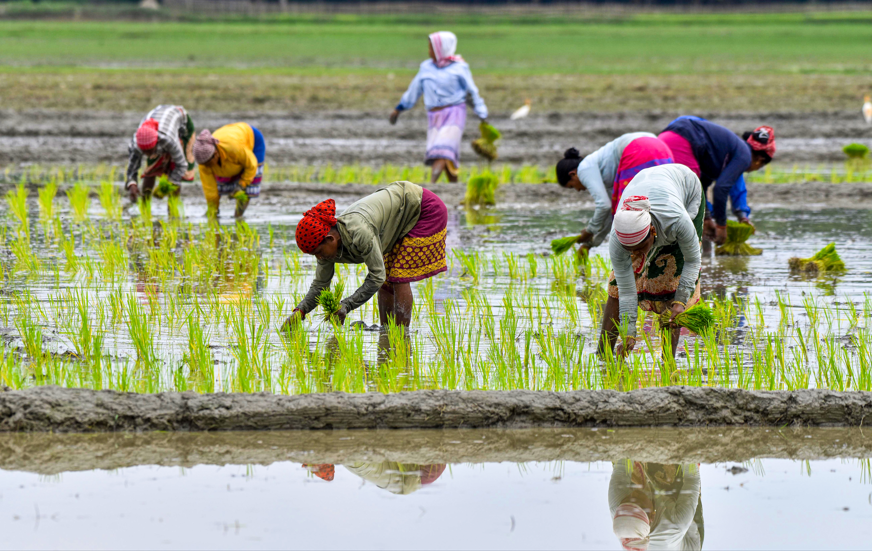
The Union government allocates ₹12,200 crore for Pradhan Mantri Fasal Bima Yojana (PMFBY) for 2026-27. The scheme continues to provide nationwide crop insurance cover, and the article lists its coverage, premium structure, implementation status in Kharif 2026, and technology systems used for enrolment, yield estimation, claim settlement, and grievance redressal.
Pradhan Mantri Fasal Bima Yojana:
| Dimension | Key Details |
|---|---|
| Launch | PMFBY has been launched on 18 February 2016. |
| Coverage | PMFBY provides for coverage against: droughts, floods, cyclones, hailstorms, pests, diseases, prevented sowing, localized calamities, damage by inundation, unseasonal rainfall, hailstorms, and specified post-harvest losses. |
| Crop-cycle risk coverage | PMFBY provides for coverage from pre-sowing (including prevented or failed sowing), mid-season adversity, localized calamities at individual land parcels, and post-harvest losses caused by cyclones, unseasonal rains, and other specified perils. |
| Eligibility | PMFBY provides for coverage to farmers, including tenant farmers and sharecroppers, subject to prescribed eligibility conditions. |
| Insurable interest and documents | PMFBY applies to farmers who have an insurable interest, valid land documents or tenure agreements or sowing certificates as per state-specific pre-defined requirements, and who apply within the specified timeframe. |
| Loanee and non-loanee farmers | PMFBY comprises coverage for both loanee and non-loanee farmers, and non-loanee farmers can voluntarily enroll under the scheme. |
| Premium payment mechanism | PMFBY provides that loanee farmers’ premiums are automatically deducted from the loan amount by the respective banks. |
| Premium rates | PMFBY provides that farmers pay a maximum premium of 2% for Kharif and 1.5% for Rabi foodgrain and oilseed crops, and 5% for commercial and horticultural crops. |
| Premium subsidy sharing | PMFBY provides that the Central and State Governments subsidize the remaining premium in a 50:50 proportion. |
| Premium subsidy sharing | PMFBY provides that for North-Eastern and Himalayan States/UTs, the Central and State Government subsidy contribution is in a 90:10 proportion. |
| Non-coverage | PMFBY excludes losses in non-notified areas, outside the covered crop lifecycle (before sowing and after removal of the crop from the field), losses caused by negligence or man-made or preventable risks, and losses from war, nuclear risks, riots, theft, and specified post-harvest conditions. |
| Risk categories and quantitative limits | PMFBY provides for: yield losses on notified area basis; prevented sowing claims up to 25% of the sum insured; post-harvest losses for crops in “cut-and-spread” condition for up to 14 days after harvesting against specified cyclonic and unseasonal rain events; and localized calamities including hailstorms, landslides, inundation, cloud bursts, and damage by natural fire under specified conditions. |
| Implementation status | PMFBY is currently being implemented by 25 States and Union Territories in Kharif 2026. |
| Coverage and claims since inception | Since inception, more than 92.46 crore farmer applications have been insured, and over 26.33 crore farmer applications have received claims exceeding ₹2.06 lakh crore. |
| Kharif 2025 coverage | In Kharif 2025, crop insurance has covered 229.77 lakh farmers and 269.38 lakh hectares. |
| Kharif 2026 coverage | As of 27 August 2026, 241.38 lakh farmers have been insured, covering 278.12 lakh hectares. |
| Kharif 2025 claims paid | For Kharif 2025, claims worth ₹9,837.61 crore have already been paid to 60.89 lakh eligible farmers. |
| State rejoining | Andhra Pradesh has rejoined from Kharif 2022, Jharkhand has rejoined from Kharif 2024, West Bengal has rejoined from Kharif 2026, and Bihar has decided to implement PMFBY starting from Rabi 2026-27. |
| National Crop Insurance Portal | NCIP provides for digital farmer enrolment, subsidy administration, coordination, and information dissemination, and it facilitates calculation of eligible claims and electronic transfer of claims directly into farmers’ bank accounts. |
| Land records integration with NCIP | Digital validation of land records is being implemented in Madhya Pradesh, Chhattisgarh, Andhra Pradesh, Maharashtra, Rajasthan, Karnataka, Haryana, Himachal Pradesh, Uttar Pradesh, and Odisha, and around 85% of the insured area in these States is validated through integrated land records. |
| DigiClaim and claim payment system | DigiClaim has been introduced from Kharif 2022, claims are processed through NCIP and paid through the Public Finance Management System (PFMS), and since inception, more than ₹55,000 crore in claims have been calculated and paid through the digital platform. |
| CCE-Agri App | CCE-Agri App provides for digital capture and uploading of Crop Cutting Experiment (CCE) yield data on NCIP, and this yield data is used for calculation of Actual Yield for an Insurance Unit for claim calculation. |
| YES-TECH | YES-TECH provides for remote sensing and technology-based crop yield estimation, it has been launched for paddy and wheat in Kharif 2023 and soybean in Kharif 2024, and the weightage assigned to YES-TECH-derived yields has now increased up to 50% across certain states. |
| WINDS | WINDS provides for hyperlocal weather data collection at Block and Gram Panchayat levels using Automatic Weather Stations and Automatic Rain Gauges, and the data supports the Weather-Based Crop Insurance Scheme for fruits, vegetables, and plantation crops; YES-TECH yield estimation; disaster management; weather forecasting; and other parametric insurance products. |
| CROPIC | CROPIC provides for geo-tagged photographs to periodically validate general crop health in an Insurance Unit, and it is envisaged to support crop damage assessment and yield estimation through pictorial analytics with nation-wide pilots in the process of initiation. |
| Krishi Rakshak Portal & Helpline | KRPH provides for a dedicated toll-free helpline 14447, it has been launched in January 2024 across the nation, and since then, 26.12 lakh grievances have been addressed and resolved with 99.66% resolution rate. |
| AIDE and CLAP | AIDE provides for doorstep enrolment of non-loanee farmers through insurance intermediaries, and CLAP provides for digital recording of crop loss extent at individual farm level under localized calamities through crop loss surveys for faster claim calculation and settlement. |
| Restructured Weather-Based Crop Insurance Scheme | RWBCIS provides for a weather index-based scheme where admissible claims are determined using specified weather parameters as a proxy for crop damage rather than actual assessed crop-yield losses, it operates on an Area Approach in defined Reference Unit Areas (RUAs), and in Kharif 2026 it covers 25.95 lakh farmer applications and 12.31 lakh hectares. |
| RWBCIS triggers and add-on coverage | RWBCIS provides that payouts are triggered when notified weather variables, including deficit or excess rainfall, dry spells, extreme temperatures, humidity, and wind speed, deviate from pre-defined thresholds, and States/UTs can offer add-on farm-level coverage for severe localized perils such as hailstorms and cloudbursts. |
| RWBCIS premium rates | RWBCIS provides for the same premium rates as PMFBY in the range of 1.5% to 5% depending on crop type. |