Q 52 / 370
UPSC CSE Prelims 2025
If 4 ≤ x ≤ 8 and 2 ≤ y ≤ 7, then what is the ratio of maximum value of (x + y) to minimum value of (x − y)?
EXPLANATION
Correct Option (4)
Given the intervals for variables x and y:
- `4 ≤ x ≤ 8`
- `2 ≤ y ≤ 7`
To determine the maximum value of `(x + y)`:
- The maximum value of `x` is 8.
- The maximum value of `y` is 7.
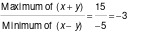
- Therefore, the maximum value of `(x + y)` = 8 + 7 = 15.
To determine the minimum value of `(x − y)`:
- To minimize a difference, the first term (`x`) should be at its minimum, and the second term (`y`) should be at its maximum.
- The minimum value of `x` is 4.
- The maximum value of `y` is 7.
- Therefore, the minimum value of `(x − y)` = 4 − 7 = −3.
The required ratio is the maximum value of `(x + y)` to the minimum value of `(x − y)`:
- Ratio = `15 / (−3)` = −5.
Since the calculated ratio of −5 is not listed among options 1, 2, or 3, option 4, "None of the above," is the correct answer.
Incorrect Options:
Options 1, 2, and 3 are incorrect because the precisely calculated ratio of the maximum value of `(x + y)` to the minimum value of `(x − y)` is −5. This value does not correspond to 6, `15/2`, or `–15/2`.