UPSC CSE Prelims 2021
There are three Points P, Q and R on a straight line such that PQ: OR = 3 : 5. If n is the number of possible values of PQ : PR, then what is n equal to?
EXPLANATION
Correct Option (2)
Let P, Q, and R be three points on a straight line. The given ratio is PQ:QR = 3:5.
We need to determine the number of possible values for the ratio PQ:PR. This depends on the relative order of the points on the line.
There are two valid arrangements of these points that satisfy the given ratio:
-
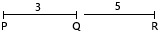
Case 1: Q lies between P and R (P-Q-R).
In this arrangement, the total length PR is the sum of PQ and QR.
Let PQ = 3k and QR = 5k for some positive constant k.
Then, PR = PQ + QR = 3k + 5k = 8k.
The ratio PQ:PR = 3k : 8k = 3:8.
-
Case 2: P lies between Q and R (Q-P-R or R-P-Q).
In this arrangement, the total length QR is the sum of QP (which is PQ) and PR.
Let PQ = 3k and QR = 5k.
Then, QR = PQ + PR.
5k = 3k + PR.
PR = 5k - 3k = 2k.
The ratio PQ:PR = 3k : 2k = 3:2.
Other possible arrangements of three points on a line (e.g., R between P and Q, or Q between R and P where P is not an endpoint) would lead to contradictions with the given ratio PQ:QR = 3:5 (e.g., resulting in negative lengths for segments).
Thus, there are exactly two distinct possible values for PQ:PR (3:8 and 3:2).
Therefore, n = 2.
Incorrect Options:
Options 1, 3, and 4 are incorrect because, as demonstrated, there are precisely two distinct geometric arrangements of the points P, Q, and R on a straight line that satisfy the given ratio PQ:QR = 3:5. Each arrangement yields a unique value for the ratio PQ:PR. Consequently, the number of possible values, n, is 2, not 1, 3, or 4.