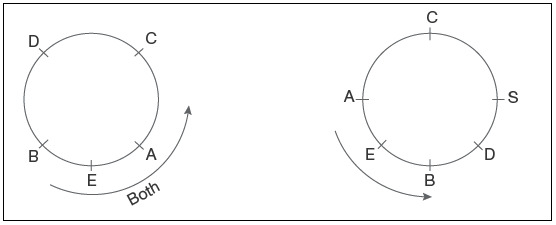
UPSC CSE Prelims 2016
Five people A, B, C, D and E are seated about a round table. Every chair is spaced equidistant from adjacent chairs.
- C is seated next to A
- A is seated two seats from D
- B is not seated next to A
On the basis of above information, which of the following must be true?
- D is seated next to B
- E is seated next to
- D and C are separated by two seats
EXPLANATION
Correct Option
The problem involves arranging five people (A, B, C, D, E) around a round table with equidistant chairs, based on specific conditions. We must determine which of the given statements (I, II, III) are invariably true across all valid arrangements.
Interpretation of Conditions:
- "C is seated next to A": C and A are adjacent.
- "A is seated two seats from D": This implies there are exactly two people between A and D. For a 5-person circular arrangement, if A is at position 1, D must be at position 4 (e.g., A-X-X-D-X).
- "B is not seated next to A": B and A are not adjacent.
Regarding statement II, the original question has a typo "E is seated next to". Assuming the most plausible intent to make the options consistent, we will evaluate "E is seated next to A".
Derivation of Possible Arrangements:
Let's fix A's position. Due to the circular nature, this does not affect the relative arrangements.
- Place A. Based on condition 2, place D two seats away from A.
A _ _ D _
- Place C next to A (condition 1). There are two possibilities for C's position:
-
Case 1: C is to A's immediate right.
A C _ D _
The remaining seats are for B and E. Based on condition 3, B is not next to A. Since C is already next to A, B cannot be in the seat adjacent to A on the other side. B also cannot be in the seat next to A where C is. Therefore, B must occupy the seat between C and D.A C B D _
The last remaining person, E, takes the last seat.Arrangement 1: A C B D E (clockwise)
-
Case 2: C is to A's immediate left.
A _ _ D C
The remaining seats are for B and E. Based on condition 3, B is not next to A. Since C is already next to A, B cannot be in the seat adjacent to A on the other side. B also cannot be in the seat next to A where C is. Therefore, B must occupy the seat between D and the empty seat next to A.A _ B D C
The last remaining person, E, takes the last seat.Arrangement 2: A E B D C (clockwise)
-
Case 1: C is to A's immediate right.
Both Arrangement 1 (A-C-B-D-E) and Arrangement 2 (A-E-B-D-C) satisfy all given conditions.
Evaluation of Statements:
We now check which of the given statements must be true in both valid arrangements.
Statement I: D is seated next to B.
- In Arrangement 1 (A-C-B-D-E): D is next to B. (True)
- In Arrangement 2 (A-E-B-D-C): D is next to B. (True)
Therefore, Statement I must be true.
Statement II: E is seated next to A. (Assuming correction from "E is seated next to")
- In Arrangement 1 (A-C-B-D-E): E is next to A. (True)
- In Arrangement 2 (A-E-B-D-C): E is next to A. (True)
Therefore, Statement II must be true.
Statement III: D and C are separated by two seats. (Meaning two people are seated between them)
- In Arrangement 1 (A-C-B-D-E):
- Clockwise from C to D: C-B-D (1 person, B, between them).
- Anti-clockwise from C to D: C-A-E-D (2 people, A and E, between them).
- In Arrangement 2 (A-E-B-D-C):
- Clockwise from C to D: C-A-E-B-D (3 people between them).
- Anti-clockwise from C to D: C-D (0 people, they are adjacent).
Since Statement III is not true in all possible valid arrangements (specifically, it is false in Arrangement 2), Statement III does not necessarily have to be true.
Based on this analysis, only statements I and II must be true.
Incorrect Options:
The analysis shows that Statement I and Statement II (with the assumed correction) are always true, while Statement III is not always true. Therefore, options that include only Statement I, only Statement III, or neither I nor II nor III are incorrect.