Q 26 / 45
UPSC CSE Prelims 2016
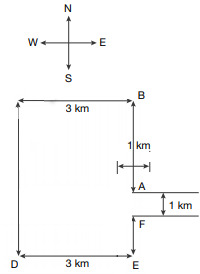
A person X was driving in a place where all roads ran either north-south or east-west, forming a grid. Roads are at a distance of 1 km from each other in a parallel. He started at the intersection of two roads, drove 3 km north, 3 km west and 4 km south. Which further route could bring him back to his starting point, if the same route is not repeated?
EXPLANATION
Correct Option (B)
The person's journey can be tracked using a coordinate system, assuming the starting intersection is the origin (0,0).
- Initial position: (0,0)
- After driving 3 km north: Position becomes (0, 3).
- After driving 3 km west: Position becomes (-3, 3).
- After driving 4 km south: Position becomes (-3, 3 - 4) = (-3, -1).
To return to the starting point (0,0) from the current position of (-3, -1), the following movements are required:
- To move from x = -3 to x = 0, the person must travel 3 km east.
- To move from y = -1 to y = 0, the person must travel 1 km north.
Thus, the route "3 km east, then 1 km north" will bring the person back to the starting point.
Incorrect Options:
- Option A (3 km east, then 2 km south): From the final position (-3, -1), moving 3 km east leads to (0, -1). Subsequently, 2 km south leads to (0, -3), which is not the starting point.
- Option C (1 km north, then 2 km west): From the final position (-3, -1), moving 1 km north leads to (-3, 0). Subsequently, 2 km west leads to (-5, 0), which is not the starting point.
- Option D (3 km south, then 1 km north): From the final position (-3, -1), moving 3 km south leads to (-3, -4). Subsequently, 1 km north leads to (-3, -3), which is not the starting point.