UPSC CSE Prelims 2014
Consider the following statements:
- There are six villages A, B, C, D, E and F.
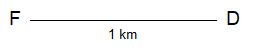
- F is 1 km to the west of D.
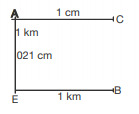
- B is 1 km to the east of E.
- A is 2 km to the north of E.
- C is 1 km to the east of A.
- D is 1 km to the south of A.
Which three villages are in a line?
EXPLANATION
Correct Option (B)
To determine which villages are in a line, we establish their relative positions based on the given statements:
- A is 2 km to the north of E.
- D is 1 km to the south of A. This implies D is located between A and E. Specifically, D is 1 km north of A's southern point, which places D 1 km north of E (since A is 2 km north of E).
Therefore, E, D, and A are situated along the same vertical axis, forming a straight line. E is at the southernmost point, D is 1 km north of E, and A is 1 km north of D.
Incorrect Options:
-
A, C, B:
A is 2 km north of E. C is 1 km east of A. B is 1 km east of E. This arrangement places A and C on a horizontal line, and E and B on another horizontal line, but A, C, and B do not align on a single straight line.
-
C, B, F:
C is 1 km east of A. B is 1 km east of E. F is 1 km west of D. Considering the established positions, C and B are on the eastern side relative to A and E, respectively. F is on the western side relative to D. These three villages do not share a common axis to form a straight line.
-
E, B, D:
E and B are on a horizontal line (B is 1 km east of E). D is 1 km south of A, and A is 2 km north of E. This places D north of E. Therefore, E, B, and D do not form a straight line as D is not on the same horizontal or vertical axis as E and B.