UPSC CSE Prelims 2014
Consider the following matrix with one empty block in the lower extreme corner:
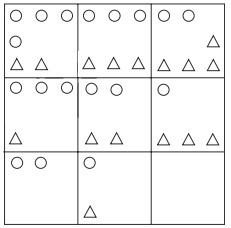
Which of the following figures could fit in the empty block and thus complete the matrix?
EXPLANATION
Correct Option (3)
The matrix follows a consistent pattern for the arrangement of 'O' (circles) and '∆' (triangles) across both rows and columns. To determine the figure for the empty block in the lower extreme corner (R3C3), these patterns must be applied:
- Row-wise Pattern:
- The number of 'O's decreases from left to right.
- The number of '∆'s increases from left to right.
- Column-wise Pattern:
- The number of 'O's decreases from top to bottom.
- The number of '∆'s decreases from top to bottom.
Therefore, the figure in the empty block (R3C3) must exhibit the following characteristics relative to its adjacent elements:
- The count of 'O's must be less than the 'O's in R3C2 and R2C3.
- The count of '∆'s must be greater than the '∆'s in R3C2 but less than the '∆'s in R2C3.
Option (3) is the only figure that satisfies all these conditions, maintaining the established decreasing trend for 'O's in both its row and column, the increasing trend for '∆'s in its row, and the decreasing trend for '∆'s in its column.
Incorrect Options:
Options (1), (2), and (4) are incorrect because they fail to adhere to one or more of the established patterns within the matrix:
- Some options might show an increasing number of 'O's in a row or column, violating the decreasing trend for 'O's.
- Other options might present a decreasing number of '∆'s in a row, contrary to the required increasing trend.
- Alternatively, certain options could display an increasing number of '∆'s in a column, which would contradict the established decreasing trend for '∆'s in columns.
- Any figure that does not simultaneously satisfy all four conditions (O's decreasing row-wise, ∆'s increasing row-wise, O's decreasing column-wise, ∆'s decreasing column-wise) cannot complete the matrix.