|
Icarus Study Reconstructs Ancient Valles Marineris Flood on Mars
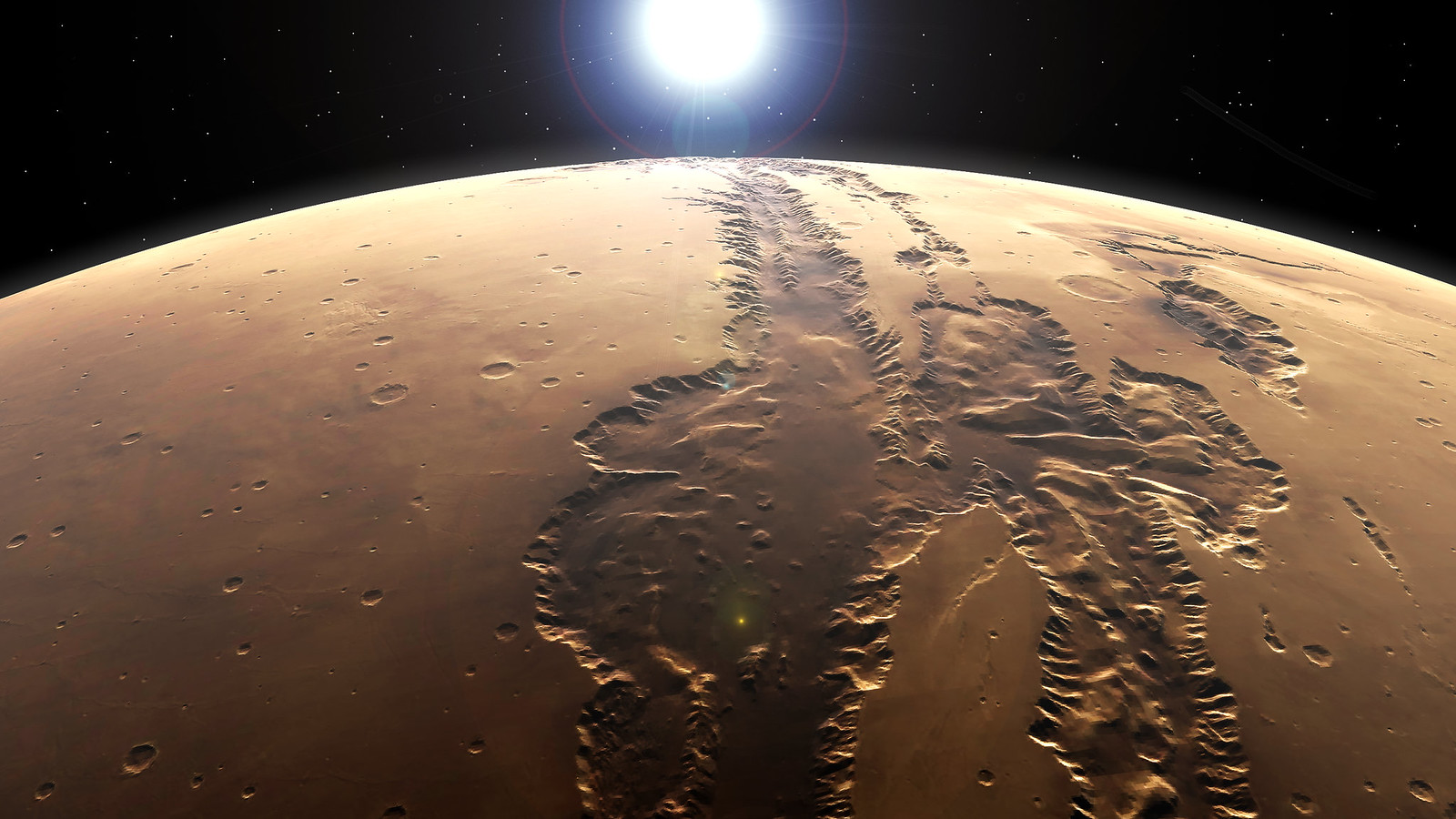
A recent study published in the peer-reviewed journal Icarus reconstructs evidence of a significant ancient flood event on Mars. The study links the flood’s origin to the Valles Marineris canyon system and uses two -dimensional hydraulic modelling to estimate the flood volume and its potential global impact.
Icarus Study:
| Dimension | Key Details |
|---|---|
| Estimated Flood Volume | Researchers estimate that the flood releases approximately 1,245 trillion cubic metres of water. |
| Estimated Global Impact | This event may increase the global mean level of the hypothesised ancient Martian ocean by approximately 34 metres. |
| Method Used | The study employs two-dimensional hydraulic modelling to reconstruct the flood and assess its potential impact. |
| Valles Marineris: Description | Valles Marineris is a gigantic canyon system on Mars. |
| Valles Marineris: Record | It is the largest canyon system in the Solar System. |
| Valles Marineris: Extent | The canyon extends for more than 4,000 kilometers. |
| Valles Marineris: Location | It is situated broadly along the equatorial region of Mars. |
| Valles Marineris: Past Water Presence | Researchers believe that Valles Marineris once contains extensive bodies of water, including paleolakes. |
| Paleolake | Paleolake refers to an ancient lake that exists during the geological past but no longer persists in its original form. |
| Evidence of Ancient Water on Mars | Evidence includes the following features: ancient valleys, lake basins, sedimentary deposits, delta-like landforms, channel systems, and Oceanus Borealis. |
| Oceanus Borealis | Oceanus Borealis denotes a hypothesized ancient ocean that is proposed to have covered portions of the northern lowlands on Mars. |